

UNGA81: Stronger health systems must start with local control – Mahama
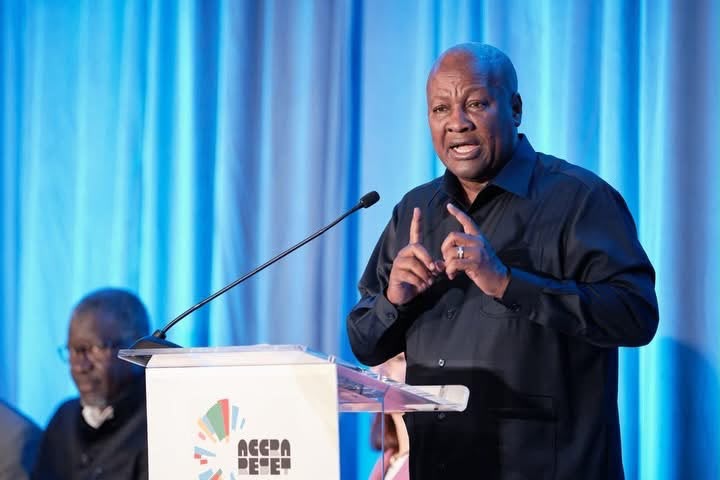
President John Dramani Mahama has called for greater control over health systems in the Global South. He said countries must have more control over the decisions and resources that shape their health sectors.
President Mahama made the call on Monday, September 21, 2026, in New York. He was speaking at a high-level side event on the Accra Reset: Global Reset Dialogue during the 81st United Nations General Assembly.
The event also marked the launch of the High-Level Panel report, A Sovereign Future for Health.
The report contains 10 recommendations for reforming global health governance. It also focuses on strengthening national and regional health systems.
President Mahama said the Accra Reset was created to address three key challenges facing the Global South.
These are geostrategic marginalisation, geopolitical vulnerability and donor dependence.
He said the three challenges are connected. He also called for a new approach based on political authority, productive capacity and financial resilience.
President Mahama questioned the idea of “country ownership” when major decisions remain outside the countries expected to implement health programmes.
“For decades, nations of the Global South have been asked to own the results of health and development programmes, while others retain the control,” he said.
He said countries must have a stronger role in shaping their own health policies.
“Today, through the Accra Reset, we declare unequivocally that there can be No Ownership Without Control.”
The President, however, said greater control must come with greater accountability.
He warned that transferring power from international institutions to national governments would not automatically create sovereignty.
“But let me be equally frank with my brothers and sisters across the Global South. Moving power from distant boardrooms in Geneva or Washington into an unaccountable ministry in Accra, Abuja, or anywhere else will not magically manifest sovereignty either,” he said.
President Mahama said countries seeking greater control must also manage their resources responsibly.
“If we demand control, we must earn it through uncompromising domestic accountability,” he said.
He pointed to Ghana’s Resetting Ghana Agenda as part of efforts to improve fiscal management, fight corruption and strengthen accountability.
He said the same principle should guide countries across the Global South.
“The same principle applies across the Global South: No ownership without control, yes—but no control without absolute accountability to our people,” he stated.
President Mahama described this approach as the foundation of a New Global Bargain.
He said the new approach should link responsibility with authority and authority with productive capacity.
The President also outlined the next steps for the Accra Reset.
Ghana and the Presidential Council will work with governments, global health organisations, development finance institutions, philanthropies and private-sector partners.
The goal is to turn the recommendations in A Sovereign Future for Health into practical country-level agreements.
President Mahama also invited partners from Africa, Asia, the Gulf and other regions to support networks focused on research, regulation, local manufacturing and distribution.
He stressed that health sovereignty does not mean ending international cooperation.
“Let me be clear; this sovereign health agenda is not a retreat into isolationism,” he said.
“We are seeking pragmatic interdependence: a mature, equal partnership where we see one another as equals.”
President Mahama said stronger health systems in Africa and Asia would make the world safer.
He also identified maternal and child health as a major test of the proposed reforms.
The Accra Reset will now move from policy design to implementation. Ghana and its partners are expected to focus on health financing, local manufacturing, regional cooperation and accountability.
President Mahama said the ultimate goal is to ensure that global health cooperation delivers practical results for people, particularly in countries of the Global South.
About The Author

 UNGA81: Ghana will push for stronger African voice under AU Chairmanship – Mahama
  UNGA81: Ghana has achieved a ‘dramatic economic turnaround’ – Mahama
  UNGA81: ‘No race Is superior; no nation Is inferior’ – Mahama
  UNGA81: ‘Critical mineral extraction must not replicate colonial-era exploitation’ – Mahama
  Ayariga pauses Agbogbloshie 24-hour economy market project
  No increase in electricity and water Tariffs from Thursday, October 1 – PURC
  BoG to introduce new Ghana Cedi notes in November