

Kufuor: Protect democratic institutions from political interference
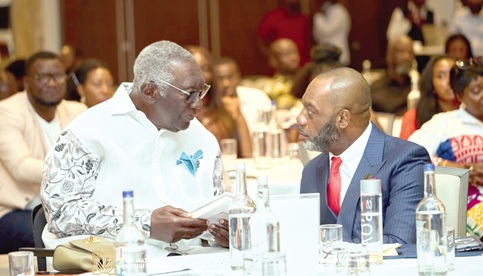
Former President John Agyekum Kufuor has called on political leaders and citizens to protect Ghana’s democratic institutions from political interference, warning that no electoral victory gives a party ownership of the state.
He said institutions such as Parliament, the Judiciary, the media and independent constitutional bodies must be allowed to operate freely and effectively if Ghana is to preserve and strengthen its democratic credentials.
Mr Kufuor made the remarks while speaking at the 2026 Busia Institute Lecture held in London on Sunday under the theme, “Centre-Right Political Thought in Africa: The Ghanaian Experience.”
The event attracted diplomats, Members of Parliament, Ghanaian professionals, members of the Ghanaian community in the United Kingdom and other invited guests who gathered to reflect on the legacy and future of centre-right political thought in Africa.
Addressing participants, the former President stressed that democratic governance requires respect for institutions and political tolerance, regardless of which party is in power.
“An opponent remains a fellow citizen, and a temporary majority does not own the republic,” Mr Kufuor said.
According to him, the strength of a democracy is measured not only by the conduct of elections but also by the ability of institutions to function independently and uphold the rule of law.
He cautioned political actors against treating state institutions as extensions of partisan interests, noting that such actions could undermine public confidence in governance and weaken democratic accountability.
Mr Kufuor said Ghana’s democratic progress over the years had been built on the foundations of constitutional government, individual liberty and institutional respect, principles that must continue to guide political leadership.
He further argued that the future credibility of the country’s centre-right tradition would depend on whether its adherents remained committed to constitutionalism, social responsibility, private enterprise and restraint in the exercise of political power.
The former President also reflected on key policies implemented during his administration, saying they represented efforts to translate political principles into practical outcomes for citizens.
Among the initiatives he highlighted were the repeal of the criminal libel laws, Ghana’s completion of the Highly Indebted Poor Countries (HIPC) initiative, the establishment of the National Health Insurance Scheme, the expansion of access to basic education and the Millennium Challenge Compact.
Mr Kufuor said these measures were designed not only to improve socio-economic conditions but also to strengthen democratic governance and public participation.
He noted that political traditions should ultimately be judged by the values they uphold and the impact they have on the lives of citizens rather than by electoral victories alone.
Delivering the keynote address, leading New Patriotic Party (NPP) member Dr Matthew Opoku Prempeh echoed the need for political parties to focus on ideas, service and institution-building.
He argued that political traditions could not survive on the achievements of their founders or memories of past electoral successes.
“A political party earns its place not by winning offices, but by becoming an institution of memory, of ideas and of honest leadership,” Dr Prempeh said.
He said each generation of political leaders must prove through its conduct and commitment to public service that it deserves the heritage it claims.
Dr Prempeh further called for an objective and evidence-based assessment of the administration of Professor Kofi Abrefa Busia during Ghana’s Second Republic.
According to him, such an assessment should consider the government’s constitutional philosophy, policy decisions, achievements, shortcomings and the historical context in which it operated.
He said a balanced understanding of political history was essential for strengthening democratic discourse and informing future leadership.
Chairman of the event, Bernard Owusu, stressed that democracy must not be viewed solely through the lens of elections.
He argued that democratic governance also depended on responsible citizenship, tolerance, institutional strength and unwavering respect for the rule of law.
“Democracy should not be reduced to elections,” Mr Owusu said.
He explained that while elections are important, the survival of democracy requires citizens and leaders alike to uphold democratic values between electoral cycles.
Mr Owusu therefore called for greater civic responsibility and stronger commitment to the institutions that sustain democratic governance.
The Executive Director of the Busia Institute, Dr Anane Agyei, also underscored the importance of evaluating political traditions based on their ideas and impact on society.
He said political movements should be assessed by how they exercise authority, build institutions and improve the lives of citizens.
“The ideas they defend, the institutions they build, the manner in which they exercise public authority and their effect on the lives of citizens” should be the true measure of political traditions, Dr Agyei stated.
The discussions throughout the lecture focused on the relationship between political ideology, governance and national development, with speakers emphasizing the need for strong institutions and responsible leadership.
Participants agreed that Ghana’s democratic future would depend largely on the ability of political actors to place national interest above partisan considerations and to protect the institutions that safeguard constitutional rule.
Mr Kufuor’s remarks served as a reminder that democracy thrives when institutions are respected and protected from undue political influence.
His call for the defence of democratic institutions also reinforced the principle that political power is temporary, while the state and its institutions belong to all citizens.
About The Author

 UNGA81: Ghana will push for stronger African voice under AU Chairmanship – Mahama
  UNGA81: Ghana has achieved a ‘dramatic economic turnaround’ – Mahama
  UNGA81: ‘No race Is superior; no nation Is inferior’ – Mahama
  UNGA81: ‘Critical mineral extraction must not replicate colonial-era exploitation’ – Mahama
  Ayariga pauses Agbogbloshie 24-hour economy market project
  Ghanaians Abroad stage protest, demand accountability from Mahama gov’t at UN
  BoG to introduce new Ghana Cedi notes in November